
10종 마디풀과(Polygonaceae) 식물 종자의 품질 및 항산화 활성
This is an open access article distributed under the terms of the Creative Commons Attribution Non-Commercial License (http://creativecommons.org/licenses/by-nc/3.0/) which permits unrestricted non-commercial use, distribution, and reproduction in any medium, provided the original work is properly cited.
Abstract
This study aimed to explore natural antioxidants of plant origin by evaluating the antioxidant activity of seed extracts from Polygonaceae species.
The seeds used in the experiment had a filled-seed percentage of at least 89% and a germination rate exceeding 50%. The total phenolic content was highest in Rumex crispus (10.8 ㎎ GAEs/g seed), followed by Rumex obtusifolius (8.3 ㎎ GAEs/g seed). The total flavonoid content was highest in Reynoutria sachalinensis (1.7 ㎎ QEs/g seed), followed by Persicaria sagittata (1.5 ㎎ QEs/g seed). The DPPH radical scavenging activity, based on EC50 values, was highest in Rumex crispus (5.5 μg/ml) and Rumex obtusifolius (7.5 μg/ml). The ABTS radical scavenging activity, also based on EC50 values, was highest in Rumex crispus (1.5 μg/ml) and Rumex obtusifolius (2.0 μg/ml). In the FRAP assay, Rumex crispus (9118.0 μM Fe(II)/g extract) and Rumex obtusifolius (7334.4 μM Fe(II)/g extract) exhibited the highest antioxidant capacities. Based on hierarchical clustering analysis of antioxidant activities, the ten species were classified into three groups, ranging from low (Group 1) to high (Group 3) activity.
Rumex crispus and Rumex obtusifolius were classified into Group 3, demonstrating the highest antioxidant potential.
Keywords:
Polygonaceae, Antioxidant, Conservation, Radical Scavenging Activity, Seed서 언
자생식물의 유용한 특성을 분석하여 새로운 가치를 발굴하고 다양한 분야에서 활용도를 높이기 위한 광범위한 연구가 이루어지고 있다. 이러한 연구는 식물자원의 경쟁력을 확보하고 식물을 보전하는데 매우 중요하다. 한반도에는 3,954종의 식물이 자생하고 있지만, 이들의 상업적 및 농업적 활용은 여전히 제한적이다 (Korean National Arboretum, 2025). 그러므로 자생식물 유전자원의 새로운 활용 가능성을 발굴하고 그 가치를 제고하기 위해서는 이들의 잠재력을 조사하는 것이 필요하다.
식물 유용성 평가는 항산화, 항당뇨, 항균 같은 생리활성이 핵심이며, 특히 항산화 활성은 인체의 산화 스트레스를 조절해 레독스 항상성을 유지하는데 중요한 역할을 한다 (Yang et al., 2022; Jomova and Valko, 2023). 인체의 항산화 체계는 효소와 비효소로 이루어진 내인성 요소와 항산화제 섭취를 통한 외인성 요소가 함께 작동하지만, 산화 스트레스가 과도하면 이러한 체계가 무너질 수 있다 (Jomova and Valko, 2024). 또한, 항산화 활성이 높은 음식을 섭취할수록 사망이나 심혈관 위험이 낮은 경향이 보고되고 있어, 항산화 활성이 높은 식물자원은 가치가 크다 (Ha et al., 2023; Wang et al., 2024)
여러 작물에서 종자의 페놀성 화합물과 항산화 활성이 발아능력 및 저장 중 품질 저하와 밀접한 연관이 있다고 보고하고 있다. 예를 들어, 대두 (Glycine max L.)에서는 항산화 활성이 높은 유전자원의 발아율이 높았고, 보리 (Hordeum vulgare L.)에서는 품종에 따라 결과가 다르기는 하나 발아 특성과 총 페놀성 화합물 사이의 관계를 보고하였다 (Kumar et al., 2020; Jovanovic et al., 2024).
마디풀과 식물은 전 세계적으로 널리 분포하며, 한국에는 10속 85종이 자생한다. 형태학적으로는 뚜렷한 마디와 탁엽을 가지며, 종자와 수과의 형태적 특징들은 한국 마디풀과의 분류학적 이해에 중요한 지표가 되며, 전통적으로 약용 및 식용 목적으로 사용되어 왔다 (Hong and Lee, 1983; Kang, 2012; Kong et al., 2018). 최근 연구에서 마디풀과 식물 추출물의 다양한 생리활성들이 보고되고 있으며, 그중 여뀌속 (Persicaria Mill.)은 이삭여뀌 (Persicaria filiformis (Thunb.) Nakai), 흰꽃여뀌 (Persicaria japonica (Meisn.) Nakai ex Ohki), 산여뀌 (Persicaria nepalensis (Meisn.) H.Gross) 등에서 항산화 활성뿐만 아니라, 미백 (tyrosinase 저해), 항암, 항염 효과가 밝혀졌다 (Hyun et al., 2007; Kim et al., 2019; Choi et al., 2020; Seimandi et al., 2021). 전통적인 약재로 많이 알려진 하수오속 (Reynoutria Houtt.)의 경우, 한반도 자생식물인 호장근 (Reynoutria japonica Houtt.), 왕호장근 (Reynoutria sachalinensis (F.Schmidt) Nakai)을 포함하여 항산화, 항염, 항암, 간 및 심장 보호, 기억력 개선 등 다양한 활성이 밝혀졌다 (Zhang et al., 2022). 또한, 소리쟁이속 (Rumex L.) 식물들도 항산화, 항암, 항염, 항미생물 활성 등이 밝혀졌다 (Vasas et al., 2015).
이들 식물들의 약학적 특성들의 연구는 대부분 잎이나 줄기, 뿌리와 같은 식물체 부분에 초점을 맞추고 있어 종자에 대한 연구는 제한적이다. 종자는 식물의 중요한 부분으로 항산화 활성에 기여하는 생리 활성 화합물을 함유하고 있는 것으로 알려져 있어, 종자 추출물의 항산화 잠재력을 평가하면 기능성 식품 및 의약품 소재로서 유용성에 대한 귀중한 통찰력을 얻을 수 있다.
따라서 본 연구에서는 종자은행에서 정확하게 종이 동정되고 안정적으로 저장된 시료가 확보 가능한 10종의 마디풀과 식물 종자 추출물을 대상으로 항산화 활성을 평가하고 비교하는 것을 목표로 하였다. 이러한 연구는 향후 기능성 식품 및 의약품 소재로서 활용하기 위한 기초자료로 사용하고자 실시하였다.
재료 및 방법
1. 실험 재료 및 종자 활력 평가
본 실험은 국립백두대간수목원 종자은행에서 분양받은 종자를 사용하였다 (Table 1). 시료는 마디풀과 열매로부터 과피를 최대한 제거하여 종자만을 사용하였으며, 사용된 종자 사진은 디지털 현미경 (DVM6, Leica Microsystems GmbH, Wetzlar, Germany)을 이용하여 촬영하였다 (Fig. 1). 충실률과 발아검사를 선행하여 추출을 위한 종자 상태를 평가하였으며, 먼저 X-ray (EMT-F70, Softex Co., LTD, Tokyo, Japan)를 이용하여 충실률 (Percent of filled seeds, PFS)를 조사하였다.

The list of 10 Polygonaceae plant seeds used in this experiment.
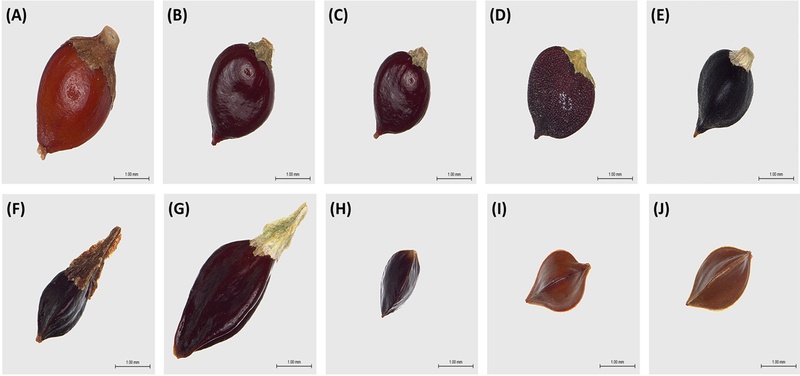
Morphology of 10 Polygonaceae plant seeds:Persicaria filiformis (Thunb.) Nakai (A), Persicaria japonica (Meisn.) Nakai ex Ohki (B), Persicaria lapathifolia (L.) Delarbre (C), Persicaria nepalensis (Meisn.) H.Gross (D), Persicaria sagittata (L.) H.Gross (E), Reynoutria japonica Houtt. (F), Reynoutria sachalinensis (F.Schmidt) Nakai (G), Rumex acetosa L. (H), Rumex crispus L. (I), Rumex obtusifolius L. (J) seeds. Scale bar; 1 mm.
각 종들의 발아조건은 SER-SID를 참고하여 설정하였다 (Society for Ecological Restoration, 2025). 앞서 조사된 발아조건 및 충실률에 따른 발아능력을 평가하기 위하여 oversowing을 위한 종자량을 계산하여 생장상 (TGL-1S, ESPEC MIC Corp., Osaka, Japan)에서 최대 30일간 배양하였다 (Davies et al., 2015). 유근이 종피를 뚫고 나오는 종자를 기준으로 매일 발아율을 조사하였으며, 최종발아율 (Percent of germination, %), T50 (Time to 50% germination, days), 평균발아소요일수 (Mean germination time, days)을 계산하였다(Dezfuli et al., 2008). 또한, 최종발아율이 50% 이하를 나타낸 종자의 경우, 선행연구를 참조하여 여뀌속 (Persicaria Mill.)은 5℃에서 8주간 저온층적 (cold stratification) 처리를, 하수오속은 1 ㎍/㎖의 GA3 침지 처리를 통해 추가적인 종자 활력을 평가하였다 (Araki and Washitani, 2000; Pipinis et al., 2016). 모든 활력 평가는 25립 4반복을 기준으로 진행하였다.
2. 종자 추출물 제조
Homogenizer (Bead Ruptor 24 Elite, Omni-International, Georgia, USA)와 액체 질소를 이용하여 곱게 간 시료의 건중량 대비 20배의 75% 메탄올 (MeOH, Macron Fine Chemicals, PA, USA)을 첨가하여 25℃에서 7일간 추출하였다. 추출 후 여과지 (0.45 μm, Hyundai Micro, Seoul, Korea)로 여과하고 evaporator (CVE-3110, EYELA, Tokyo, Japan)를 이용하여 감압 농축하였다. 추출용매를 완전히 제거한 후 dimethyl sulfoxide (DMSO, Sigma Chemical, St Louis, MO, USA)에 10 ㎎/ml의 농도로 녹인 추출물을 희석하여 본 실험에 사용하였으며, 10–1000 ㎍/㎖ 범위의 농도로 희석하여 분석하였다. 추출수율은 시료 중량 대비 추출용매가 완전히 제거된 추출물을 백분율로 나타내 계산하였다.
3. 총 페놀성 화합물 측정
총 페놀성 화합물은 Folin-Ciocalteu 시약을 활용한 Singleton 등 (1999)의 연구를 응용하여 평가하였다. 종자 추출물 20 ㎕에 40 ㎕의 증류수에 녹인 0.4 N Folin & Ciocalteu’s phenol reagent (Sigma Chemica, St Louis, MO, USA)를 넣어준 후 5분간 방치한 후, 140 ㎕ 의 700 mM Na2CO3 (Daejung, Siheung-si, Korea)를 넣어주고 상온에서 2시간 반응시켰으며, microplate reader (Multiskan go, Thermo Scientific, Vantaa, Finland)를 이용하여 765 nm에서 반응액의 흡광도를 측정하였다 (Kim et al., 2022). Gallic acid (Sigma Chemical, St Louis, MO, USA)를 표준물질로써 표준곡선을 만들어 종자 추출물 내 함량을 분석하였다.
4. 총 플라보노이드 측정
총 플라보노이드는 Christ와 Müller (1960)의 연구를 변형한 방법으로 평가하였다. 100 ㎕ 종자 추출물에 300 ㎕ 에탄올 (EtOH, Daejung, Siheung-si, Korea), 20 ㎕의 1 M potassium acetate (Junsei Chemical Co., Tykyo, Japan), 20 ㎕ 의 10% aluminum chloride (AlCl3, Junsei Chemical Co., Tykyo, Japan), 560 ㎕의 증류수를 넣고 혼합한 후 상온에서 30분간 반응시킨 후 96-well plate에 분주 후 microplate reader를 이용하여 415 nm에서 반응액의 흡광도를 측정하였다 (Kim et al., 2022). Quercetin (Sigma Chemical, St Louis, MO, USA)을 표준물질로써 표준곡선을 만들어 종자 추출물 내 함량을 분석하였다.
5. DPPH 라디칼 소거활성 평가
DPPH 라디칼 소거활성은 Blois (1958)가 제안한 방법을 참고하여 평가하였다. 종자 추출물 50 ㎕에 150 ㎕의 0.1 mM 1,1-diphenyl-2-picrylhydrazyl (DPPH, Alfa Aesar, MS, USA) 라디칼 용액을 혼합하여 30분간 암소에서 반응시켰다 (Kim et al., 2022). 그 후에 517 nm에서 microplate reader를 이용하여 반응액의 흡광도를 측정하였다 (Kim et al., 2022). 무첨가구는 종자 추출물 대신 희석 용매를 첨가하여 반응액의 흡광도를 측정하였다. 결과는 백분율로 환산한 후, EC50 값을 구하였다. Ascorbic acid (Fujifilm Wako pure chemical, Osaka, Japan)를 양성대조군으로 사용하였다.
6. ABTS 라디칼 소거활성 평가
ABTS [2,2’-azinobis(3-ethylbenzothiazoline-6-sulfonic acid)] 라디칼 소거활성은 Miller 등 (1993)의 연구를 변형하여 평가하였다. 증류수 5 ml에 140 mM potassium persulfate (K2S2O8, Acros oragnics, Geel, Belgium) 88 uL를 가한 혼합 시약에 ABTS diammonium salt tablet (Sigma Chemical, St Louis, MO, USA) 2알을 넣어 7 mM ABTS 수용액을 만들어 암실에 14 - 16시간 방치시킨 후, 이를 에탄올과 1:88의 비율로 섞어 734 nm에서 측정한 흡광도 값이 0.70 ± 0.02가 되도록 조절한 ABTS solution을 시약으로 사용하였다 (Kim et al., 2022). 96-well plate에 시료 10 ㎕와 ABTS soultion 190 ㎕를 혼합해 2분 30초간 반응시킨 뒤, 734 nm에서 반응액의 흡광도를 측정하였다 (Kim et al., 2022). 무첨가구는 종자 추출물 대신 희석 용매를 첨가하여 반응액의 흡광도를 측정하였다. 결과는 백분율로 환산한 후, EC50 값을 구하였다. Ascorbic acid (Fujifilm Wako pure chemical, Osaka, Japan)를 양성대조군으로 사용하였다.
7. Ferric reducing antioxidant power (FRAP) 평가
FRAP 평가는 Benzie와 Strain (1996)의 연구를 응용하여 수행하였다. FRAP solution은 pH 3.6의 300mM/ℓ Acetate buffer (Samchun, Pyeongtaek-si, Korea)와 40 mM/ℓ HCl (Fujifilm Wako pure chemical co., Osaka, Japan)에 녹인 10 mM/ℓ 2, 4, 6-tris(2-pyridyl)-S-triazine (TPTZ, Sigma Chemical, St Louis, MO, USA)와 20 mM/ℓ ferric chloride(Sigma Chemical, St Louis, MO, USA)를 10:1:1 비율로 실험 직전에 만들어 사용하였다 (Kim et al., 2022). 10 ㎕의 시료와 FRAP solution 200 ㎕를 혼합하여 37℃에서 4분간 반응시킨 후, 593 nm에서 반응액의 흡광도를 측정하였다. FRAP value는 ferrous sulfate heptahydrate (Sigma Chemical, St Louis, MO, USA)를 표준물질로써 표준곡선을 만들어, Fe(II)의 대비 용량으로 나타내었다.
8. 통계분석
항산화 능력을 기준으로 종들을 비교하기 위해 계층적 군집분석을 실시하였다. 종자 추출물별 항산화 지표 (DPPH 라디칼 소거활성, ABTS 라디칼 소거활성, FRAP) 데이터를 Z-socre로 표준화하고 제곱 유클리디안 거리를 이용한 Ward's method의 계층적 군집분석에 사용하였다. 항산화 활성 평가 실험은 3회 반복하였으며, 통계분석은 IBM SPSS statistics v.23 (IBM, NewYork, USA)을 이용하였다.
결과 및 고찰
1. 마디풀과 식물 종자들의 활력 평가 결과
마디풀과 식물 종자들의 활력을 평가하기 위해 충실률과 최종 발아율, T50, 평균발아소요일수를 계산하였다 (Table 2). 충실률의 경우, 모든 마디풀과 식물 종자가 89% 이상으로 충실하였다. 속별 최적 발아조건인 25℃, 25/15℃에서의 최종 발아율의 경우, 산여뀌, 왕호장근, 수영 (Rumex acetosa L.), 소리쟁이 (Rumex crispus L.), 돌소리쟁이 (Rumex obtusifolius L.)가 50% 이상의 최종발아율을 나타냈으며, 그중 산여뀌와 소리쟁이가 각각 100.0%, 98.0%로 가장 높은 발아율을 나타냈다. 10% 미만의 최종발아율을 나타낸 이삭여뀌, 흰꽃여뀌, 흰여뀌 (Persicaria lapathifolia (L.) Delarbre), 미꾸리낚시 (Persicaria sagittata (L.) H.Gross), 호장근과 50%에 가까운 발아율을 나타낸 왕호장근을 포함한 6종을 대상으로 휴면타파를 위한 저온층적 처리와 GA3 처리를 진행하였다 (Table 3). 기존 선행연구와 같이 휴면타파 처리를 진행한 모든 종에서 최종발아율이 증가되는 것을 확인할 수 있었으며, 특히 10% 미만의 발아율을 나타낸 5종에 대해서는 50% 이상의 발아율 향상을 확인할 수 있었다. 발아속도의 경우, 미꾸리낚시가 T50이 1.6일, MGT가 2.3일로 가장 빨랐으며, 호장근이 T50은 7.4일, MGT가 8.0일로 가장 느리게 나타났다.
Germination traits of 10 Polygonaceae species.
Improved germination traits of 6 Polygonaceae species following cold stratification and GA3 treatments.
흰꽃여뀌와 흰여뀌의 경우, 저온층적 처해 발아율이 증진될 수 있다는 연구보고가 있으며 (Araki and Washitani, 2000), 휴면타파 처리에 의해 발아율이 향상된 종들을 대상으로 종자 휴면유형 탐색이 필요할 것으로 생각된다. 결과적으로 본 실험에서 사용된 모든 종자들은 50% 이상의 발아율을 나타냈다.
2. 마디풀과 식물 종자들의 추출수율, 총 페놀성 화합물 함량 결과
마디풀과 식물 종자 10종의 75% 메탄올 추출물의 추출수율, 총 페놀성 화합물 함량 및 총 플라보노이드 함량을 측정하였다 (Table 4). 추출수율은 2.4 - 11.5%로 다양하였으며, 그중 이삭여뀌와 산여뀌가 각각 2.9, 2.4%로 낮았으며, 왕호장근과 소리쟁이가 각각 11.5, 10.9%로 가장 높았다. 총 페놀성 화합물 함량의 경우, 0.7 - 10.8 ㎎ GAEs/g seed로 다양하였으며, 산여뀌가 0.7 ㎎ GAEs/g seed로 가장 낮게 소리쟁이가 10.8 ㎎ GAEs/g seed로 가장 높게 나타났다. 총 플라보노이드 함량의 경우, 0.3-1.7 ㎎ QEs/g seed로 다양하였으며, 이삭여뀌가 0.3 ㎎ QEs/g seed로 가장 낮게 왕호장근이 1.7 ㎎ QEs/g seed로 가장 높게 나타났다.
Extraction yield, total phenolic and flavonoid contents of 10 Polygonaceae plant seed extracts expressed in gallic acid and quercetin equivalents.
가장 높은 총 페놀성 함량을 나타낸 소리쟁이 (10.8 ㎎ GAEs/g seed)를 기준으로 밝혀진 다른 종자 추출물 중 가장 높은 페놀성 화합물 함량을 나타낸, 국화과 포천구절초 (Dendranthema zawadskii (Herbich) Tzvelev var. tenuisectum (Nakai) Kitag.) (13.5 ㎎ GAEs/g seed)보다는 낮게 꿀풀과 속단 (Phlomis umbrosa Turcz.) (6.2 ㎎ GAEs/g seed) 보다 높게 나타났다 (Kim et al., 2021; Kim et al., 2022). 또한, 전통의약품으로 사용되는 다른 마디풀과 식물들의 경우, 소리쟁이 지상부 추출물은 249.8 ㎎ GAEs/g, 애기수영 (Rumex acetosella L.) 잎 추출물은 543.2 ㎎ GAEs/100g으로 보고되었다 (Ereifej et al., 2015; Saoudi et al., 2021).
3. 마디풀과 종자들의 DPPH 라디칼 소거활성 평가 결과
마디풀과 식물 종자 추출물의 DPPH 라디칼 소거활성을 통해 소거활성이 50%일 때의 추출물 농도(EC50)를 평가하였다 (Table 5). 분석결과, EC50 농도 값은 5.5 - 63.2 ㎍/㎖로 다양하게 나타났다. 소리쟁이와 돌소리쟁이가 각각 5.5, 7.5 ㎍/㎖로 높은 활성을 나타냈으며, 이삭여뀌, 산여뀌, 미꾸리낚시가 각각 63.2, 61.8, 52.4 ㎍/㎖로 낮은 활성을 나타냈다. 특히 소리쟁이 종자의 경우, 항산화제로 널리 알려진 ascorbic acid의 EC50 값인 7.5 ㎍/㎖ 보다 높은 활성을 나타냈으며, 국내 연구에서도 소리쟁이 종자의 butanol 분획물이 ascorbic acid보다 활성이 높다는 연구 결과를 보고한 바 있다 (Suh et al., 2011).
The EC50 values for the DPPH and ATBS radical scavenging activities of 10 Polygonaceae plant seed extracts.
또한, 다른 마디풀과 식물 34종의 지상부, 지하부, 전초 추출물의 선행 연구에서는 싱아 (Aconogonon alpinum (All.) Schur) 지상부 추출물이 15.4 ㎍/㎖, 덩굴모밀 (Persicaria chinensis (L.) H.Gross) 전초 추출물이 19.2 ㎍/㎖에서 높은 DPPH 라디칼 소거활성 결과를 보고하였으며, 소리쟁이 전초 추출물은 39.1 ㎍/㎖, 뿌리 추출물은 71.1 ㎍/㎖로 보고하였다 (Choi et al., 2020).
4. 마디풀과 식물 종자들의 ABTS 라디칼 소거활성 평가 결과
마디풀과 식물 종자 추출물의 ABTS 라디칼 소거활성을 통해 소거활성이 50%일 때의 추출물 농도 (EC50)를 평가하였다 (Table 5). 분석결과, EC50 농도 값은 1.5-21.4 ㎍/㎖로 다양하게 나타났다. DPPH 라디칼 소거활성 평가 결과와 마찬가지로 소리쟁이, 돌소리쟁이가 각각 1.5, 2.0 ㎍/㎖로 가장 높은 활성을 나타냈으며, 이삭여뀌, 산여뀌, 미꾸리낚시가 12.4, 21.4, 15.6 ㎍/㎖로 낮은 활성을 나타냈다. 특히 왕호장근, 소리쟁이, 돌소리쟁이 종자의 경우, 항산화제로 널리 알려진 ascorbic acid의 EC50 값인 2.9 ㎍/㎖ 보다 높은 활성을 나타냈다.
다른 마디풀과 식물 추출물의 ABTS 라디칼 소거활성 연구를 살펴보면, 총 34종의 지상부, 전초 등의 부위별 활성 중 호장근 전초 추출물 (5.2 ㎍/㎖)과 싱아 (A. alpinum Schur) 지상부 추출물 (5.3 ㎍/㎖)이 가장 높게 나타났으며, 소리쟁이 전초와 뿌리는 각각 15.4 ㎍/㎖, 22.7 ㎍/㎖의 ABTS 라디칼 소거활성을 가진 것으로 보고되었다 (Choi et al., 2020).
5. 마디풀과 식물 종자들의 FRAP 평가 결과
마디풀과 식물 종자의 항산화 활성을 평가하기 위해 종자 추출물의 FRAP를 평가하였다 (Table 6). 분석결과, FRAP 값은 1042.4-9118.0 μM Fe(II)/g extract로 다양하게 나타났다. 소리쟁이, 돌소리쟁이가 9118.0, 7334.4 μM Fe(II)/g extract로 가장 높게 나타났으며, 산여뀌, 미꾸리낚시가 각각 1045.8, 1042.4 μM Fe(II)/g extract로 가장 낮게 나타났다. 추출수율을 반영하여 종자 무게에 따른 FRAP 값을 계산하였을 경우, 마찬가지로 소리쟁이, 돌소리쟁이가 992.4, 638.8 μM Fe(II)/g seed로 가장 높게, 산여뀌, 미꾸리낚시가 각각 25.1, 40.7로 낮게 나타났다. 또한, 본 실험의 모든 종자 추출물은 대조구(ascorbic acid)의 FRAP 값인 9953.0 μM Fe(II)/g 보다 낮은 활성이 나타났다.
The ferric reducing antioxidant power assay (FRAP) value of 10 Polygonaceae plant seed extracts.
가장 높은 FRAP 값을 나타낸 소리쟁이 종자 추출물(9118.0 μM Fe(II)/g extract)의 경우, 동일한 방법으로 보고된 다른 종자 추출물인 꿀풀 (Prunella vulgaris L. subsp. asiatica (Nakai) H.Hara) (2910.4 μM Fe(II)/g extract), 향유(Elsholtzia ciliata (Thunb.) Hyl.) (2836.2 μM Fe(II)/g extract)보다는 높게 나타났다 (Kim et al., 2022). 또한, 동일한 마디풀과인 작은버들여뀌 (Persicaria minor (Huds.) Opiz) 잎 추출물은 377.6 μM Fe(II)/g로, 소리쟁이 뿌리 추출물은 135.35. mM Fe (II)/g과 소리쟁이 열매 추출물 9.9 mM Fe (II)/g으로 보고되었다 (Maksimovic et al., 2011; Hassim et al., 2014; Eom et al., 2020).
6. 마디풀과 식물 종자들의 계층적 군집분석 결과
종자 추출물의 항산화 능력을 기준으로 마디풀과 10종을 분류하고 비교하기 위해 앞서 평가된 항산화 능력을 기반으로 군집분석을 수행하였다. DPPH 라디칼 소거활성 (EC50), ABTS 라디칼 소거활성 (EC50), FRAP (μM Fe(II)/g extract) 데이터를 이용하여 작성된 덴드로그램을 참고하여, 낮은 항상화 활성을 갖는 group 1에서부터 높은 항산화 활성을 갖는 group 3, 총 3개의 그룹으로 분류하였다 (Table 7, Fig. 2). 결과적으로 앞서 결과처럼 group 3로 분류된 소리쟁이, 돌소리쟁이 종자 추출물의 항산화 활성이 가장 높게 나타났다.
Comparison of antioxidant activity according to groups divided by hierarchical cluster analysis using DPPH·ABTS radical scavenging activity, FRAP data in 10 Polygonaceae plant seed extracts.
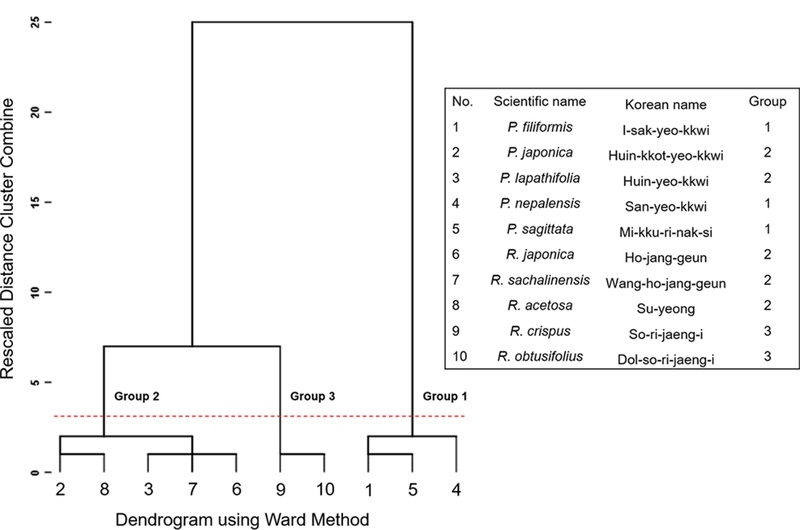
Dendrogram showing classification of datasets by a hierarchical cluster analysis using ward’s method.The datasets include DPPH radical scavenging activity (EC50), ABTS radical scavenging activity (EC50), FRAP (μM Fe(II)/g extract). The red dotted line means selection criteria for three clusters.
또한, 앞선 연구에서 소리쟁이와 돌소리쟁이의 생식기관인 꽃과 종자가 다른 부위보다 proanthocyanidin과 catechin 함량이 높고 항산화 활성 또한 높다는 결과가 보고되었으나 (Feduraev et al., 2018), 이들 종자가 높은 항산화 활성을 갖는 직접적 주요 성분들을 제시하지 못해 종자로부터 유래한 주요성분들과 이들의 항산화 활성에 대한 추가적인 연구가 필요하다.
본 연구는 마디풀과 식물 중 3가지 속에 해당하는 식물 종자들을 이용하여 분석하였으나, 군집분석 결과는 이러한 분류체계와 다른 양상을 보였다. 기존 소리쟁이속 항산화 능력의 결과가 종별로 다르며, 항산화 지표 간 상관도 일치되지 않는다고 보고하였다 (Feduraev et al., 2022). 또한, 동일 속 식물들 간에도 항산화 능력이 유의하게 달라 분류학적 근연성만으로 활성 크기를 예측하기 어렵다는 결과가 반복적으로 제시되어 왔다 (Hanen et al., 2009). 결과적으로 분류학적 접근으로 높은 항산화 능력을 설명하는 것은 어려울 것으로 판단되며, 종 특이적으로 항산화 능력이 종자에 어떠한 역할을 하는지 파악할 필요가 있어 보인다.
Bailly (2004)는 종자 저장과 발아 과정에서 지속적으로 노출된 활성산소로 인해 지질과 단백질의 산화적 손상이 발생할 수 있으며, 항산화 능력이 이러한 산화 스트레스를 완화하여 종자의 수명과 발아율을 높이는 데 핵심적이라고 보고하였다. 본 연구 결과, 가장 높은 항산화 능력을 나타낸 소리쟁이와 돌소리쟁이는 다른 종들보다 높은 발아율을 나타내 기존 선행연구와 같이 항산화 활성이 높은 종들이 발아율이 높게 나타난 결과와 유사하였다. 하지만 산여뀌와 같이 항산화 활성은 비교적 낮음에도 발아율이 높은 종 또한 존재하였다. 따라서, 종별로 종자 저장 중에 발생하는 활력감소와 항산화 활성 변화에 관한 추가적 연구를 통해, 마디풀과 식물들의 종자 품질과 항산화 활성 사이의 관계에 관한 추가적인 연구가 필요할 것으로 생각된다.
본 연구는 마디풀과 식물 10종 종자 추출물을 대상으로 항산화 능력을 평가하여, 야생식물 자원의 보전 및 활용 가능성을 높이기 위해 진행되었다. 특히, 소리쟁이 종자 추출물은 높은 활성으로 탈모방지용 샴푸와 미백용 화장품으로 활용되는 전초 추출물과 비슷한 활성을 나타내면서 (Kim, 2023; Mun, 2024), 다른 마디풀과 식물 추출물보다 높은 항산화 활성을 나타내 새로운 기능성 식품 및 의약품 소재로써 활용 가능할 것으로 평가된다. 본 연구의 결과를 통해 마디풀과를 포함하는 국내 자생식물 자원에 대한 관심이 높아지길 기대한다.
Acknowledgments
This study was carried out with the support of R&D Program for Forest Science Technology(Project No. RS-2021-KF001796)provided by Korea Forest Service (Korea Forestry Promotion Institute).
References
-
Araki S and Washitani I. (2000). Seed dormancy/germination traits of seven Persicaria species and their implication in soil seed‐bank strategy. Ecological Research. 15:33-46.
[https://doi.org/10.1046/j.1440-1703.2000.00323.x]

-
Benzie IFF and Strain JJ. (1996). The ferric reducing ability of plasma (FRAP) as a measure of “Antioxidant Power”: The FRAP assay. Analytical Biochemistry. 239:70-76.
[https://doi.org/10.1006/abio.1996.0292]
-
Blois MS. (1958). Antioxidant determinations by the use of a stable free radical. Nature. 181:1199-1200.
[https://doi.org/10.1038/1811199a0]
-
Choi YH, Lee JY, Lee JE, Jung YW, Jeong WS, Hong SS, Cho YR and Choi CW. (2020). Skin‐related properties and constituents from the aerial parts extract of Persicaria senticosa. Oxidative Medicine and Cellular Longevity. 2020:9.
[https://doi.org/10.1155/2020/6627752]
-
Christ B and Müller KH. (1960). Determination of the amount of flavonol derivatives in drugs. Archiv der Pharmazie. 293:1033-1042.
[https://doi.org/10.1002/ardp.19602931202]
- Davies R, Di SA and Newton R. (2015). Germination testing: Procedures and evaluation. Kew. 13a.
- Dezfuli PM, Sharif-Zadeh F and Janmohammadi M. (2008). Influence of priming techniques on seed germination behavior of maize inbred lines(Zea mays L.). Journal of Agricultural and Biological Science. 3:22-25.
-
Eom TK, Kim EY and Kim JS. (2020). In vitro antioxidant, antiinflammation, and anticancer activities and anthraquinone content from Rumex crispus root extract and fractions. Antioxidants. 9:726. https://www.mdpi.com/2076-3921/9/8/726, (cited by 2025 Sep 4).
[https://doi.org/10.3390/antiox9080726]
-
Ereifej KI, Feng H, Rababah T, Almajwal A, Alu’datt M, Gammoh SI and Oweis LI. (2015). Chemical composition, phenolics, anthocyanins concentration and antioxidant activity of ten wild edible plants. Food Science & Nutrition. 6:581-590. https://onlinelibrary.wiley.com/doi/10.1002/fsn3.604, (cited by 2025 Sep 4).
[https://doi.org/10.4236/fns.2015.67061]
-
Feduraev P, Chupakhina G, Maslennikov P, Tacenko N and Skrypnik L. (2019). Variation in phenolic compounds content and antioxidant activity of different plant organs from Rumex crispus L. and Rumex obtusifolius L. at different growth stages. Antioxidants. 8:237. https://www.mdpi.com/2076-3921/8/7/237, (cited by 2025 Oct 21).
[https://doi.org/10.3390/antiox8070237]
- Ha K, Liao LM, Sinha R and Chun OK. (2023). Dietary total antioxidant capacity and mortality risk in US adults: The NIH-AARP Diet and Health Study. Nutrients. 15:2258. https://pmc.ncbi.nlm.nih.gov/articles/PMC10215257/, (cited by 2025 Oct 21).
-
Hassim N, Markom M, Anuar N and Baharum SN. (2014). Solvent selection in extraction of essential oil and bioactive compounds from Polygonum minus. Journal of Applied Sciences. 14:1440-1444.
[https://doi.org/10.3923/jas.2014.1440.1444]
-
Hong SP and Lee ST. (1983). A palynotaxonomic study of the Korean Polygonaceae. Korean Journal of Plant Taxonomy. 13:63-76.
[https://doi.org/10.11110/kjpt.1983.13.2.063]
- Hyun SH, Jung SK, Jwa MK, Song CK, Kim JH and Lim SB. (2007). Screening of antioxidants and cosmeceuticals from natural plant resources in Jeju island. Korean Journal of Food Science and Technology. 39:200-208.
-
Isbilir SS and Sagiroglu A. (2013). Total phenolic content, antiradical and antioxidant activities of wild and cultivated Rumex acetosella L. extracts. Biological Agriculture & Horticulture. 29:219-226.
[https://doi.org/10.1080/01448765.2013.827992]
-
Jomova K, Raptova R, Alomar SY, Alwasel SH, Nepovimova E, Kuca K and Valko M. (2023). Reactive oxygen species, toxicity, oxidative stress, and antioxidants: Chronic diseases. Archives of Toxicology. 97:2461-2509. https://link.springer.com/article/10.1007/s00204-023-03562-9, (cited by 2025 Oct 21).
[https://doi.org/10.1007/s00204-023-03562-9]
-
Jomova K, Alomar SY, Alwasel SH, Nepovimova E, Kuca K and Valko M. (2024). Several lines of antioxidant defense against oxidative stress. Reviews in Chemical Engineering. 98:1323-1367. https://pubmed.ncbi.nlm.nih.gov/38483584/, (cited by 2025 Oct 21).
[https://doi.org/10.1007/s00204-024-03696-4]
-
Jovanović I, Frantová N, Alba-Mejía JE, Porčová L, Psota V, Asszonyi J, Cerkal R and Středa T. (2024). Role of total polyphenol content in seed germination characteristics of spring barley varieties amidst climate change. Scientific Reports. 14:23818. https://www.nature.com/articles/s41598-024-74795-6, (cited by 2025 Sep 4).
[https://doi.org/10.1038/s41598-024-74795-6]
- Kang BH. (2012). Korean Resource Plants. Korean studies information. Korean Studies information Co., LTd. Gyeonggi-do, Korea. p.17-27.
- Kim DH, Lee SK and Park HJ. (2019). Isolation of the constituents with cancer cell growth inhibition and anti-inflammatory activity from Persicaria nepalensis. Korean Journal of Pharmacognosy. 50:245-252.
- Kim J, Lee DH, Lee MH, Jung YH, Park CH, Lee HH and Na CS. (2021). Antioxidant activity of Asteraceae plant seed extracts. Journal of Life Science. 31:543-549.
-
Kim JH, Lee HH, Park CY, Kim HM, Jung YH, Kim SH and Na CS. (2022). Antioxidant activity of ten Lamiaceae plant seed extracts. Journal of Applied Biological Chemistry. 65:121-128.
[https://doi.org/10.3839/jabc.2022.017]
- Kim MJ. (2023). A method of manufacturing seborrheic scalp inflammation and hair loss relief shampoo and seborrheic scalp inflammation and hair loss relief shampoo prepared thereby. Korea Patent. 10-2506318.
-
Kong MJ, Song JH, An BC, Son SW, Suh GU, Chung MJ and Hong SP. (2018). A comparative study of achene morphology in Korean Polygonaceae. Bangladesh Journal of Plant Taxonomy. 25:135-148.
[https://doi.org/10.3329/bjpt.v25i2.39536]
- Korean National Arboretum(KNA). (2025). Korea Biodiversity Information System. https://www.nature.go.kr, (cited by 2025 Mar 12).
-
Kumar SPJ, Kumar A, Ramesh KV, Singh C, Agarwal DK, Pal G, Kuchlan MK and Singh R. (2020). Wall bound phenolics and total antioxidants in stored seeds of soybean (Glycine max) genotypes. The Indian Journal of Agricultural Sciences. 90:118-122.
[https://doi.org/10.56093/ijas.v90i1.98557]
-
Maksimović Z, Kovačević N, Lakušić B and Ćebović T. (2011). Antioxidant activity of yellow dock(Rumex crispus L., Polygonaceae) fruit extract. Phytotherapy Research. 25:101-105.
[https://doi.org/10.1002/ptr.3234]
-
Miller NJ, Rice-Evans C, Davies MJ, Gopinathan V and Milner A. (1993). A novel method for measuring antioxidant capacity and its application to monitoring the antioxidant status in premature neonates. Clinical Science. 84:407-412.
[https://doi.org/10.1042/cs0840407]
- Mun JB. (2024). A cosmetic composition having anti-oxidant, anti-inflammatory, protection of skin cell induced by untraviolet ray and skin whitening effects comrising camellia sinensis extract, rumex crispus extract and inula britannica extract. Korea Patent. 10-2692062.
-
Pipinis E, Stampoulidis A, Milios E, Kitikidou K and Radoglou K. (2016). Effects of cold stratification and GA3 on germination of Arbutus unedo seeds of three provenances. African Journal of Traditional, Complementary and Alternative Medicines. 14:318-323.
[https://doi.org/10.21010/ajtcam.v14i1.34]
-
Saoudi MM, Bouajila J, Rahmani R and Alouani K. (2021). Phytochemical composition, antioxidant, antiacetylcholinesterase, and cytotoxic activities of Rumex crispus L. International Journal of Analytical Chemistry. 2021:6675436. https://www.hindawi.com/journals/ijac/2021/6675436/, (cited by 2025 Sep 4).
[https://doi.org/10.1155/2021/6675436]
-
Seimandi G, Álvarez N, Stegmayer MI, Fernández L, Ruiz V, Favaro MA and Derita M. (2021). An update on phytochemicals and pharmacological activities of the genus Persicaria and Polygonum. Molecules. 26:5956. https://www.mdpi.com/1420-3049/26/19/5956, (cited by 2025 Sep 4).
[https://doi.org/10.3390/molecules26195956]
- Society for Ecological Restoration(SER). (2025). Seed Information Database. https://ser-sid.org, (cited by 2025 Mar 12).
-
Singleton VL, Orthofer R and Lamuela-Raventós RM. (1999). Analysis of total phenols and other oxidation substrates and antioxidants by means of folin-ciocalteu reagent. Methods in Enzymology. 299:152-178.
[https://doi.org/10.1016/S0076-6879(99)99017-1]
- Suh HJ, Kim SR, Kim MJ, Han KW, Lee HS and Kim JS. (2011). Antioxidant activities of buckwheat seed, sprout, and hull extracts. Food Science and Biotechnology. 20:461-466.
-
Vasas A, Orbán-Gyapai O and Hohmann J. (2015). The genus rumex: Review of traditional uses, phytochemistry and pharmacology. Journal of Ethnopharmacology. 175:198-228.
[https://doi.org/10.1016/j.jep.2015.09.001]
-
Wang R, Tao W and Cheng X. (2024). Association of composite dietary antioxidant index with cardiovascular disease prevalence: A cross-sectional study. Frontiers in Cardiovascular Medicine. 11:1379871. https://www.frontiersin.org/articles/10.3389/fcvm.2024.1379871/full, (cited by 2025 Oct 21).
[https://doi.org/10.3389/fcvm.2024.1379871]
-
Yang K, Cao F, Xue Y, Tao L and Zhu Y. (2022). Three classes of antioxidant defense systems and the potential role of polyphenols. Frontiers in Physiology. 13:840293. https://www.frontiersin.org/journals/physiology/articles/10.3389/fphys.2022.840293/full, (cited by 2025 Oct 21).
[https://doi.org/10.3389/fphys.2022.840293]
-
Zhang ZL, Li YZ, Wu GQ, Zhang DD, Deng C, Wang ZM, Song XM and Wang W. (2022). A comprehensive review of traditional uses, phytochemistry and pharmacology of Reynoutria genus. Journal of Pharmacy and Pharmacology. 74:1718-1742.
[https://doi.org/10.1093/jpp/rgac068]